
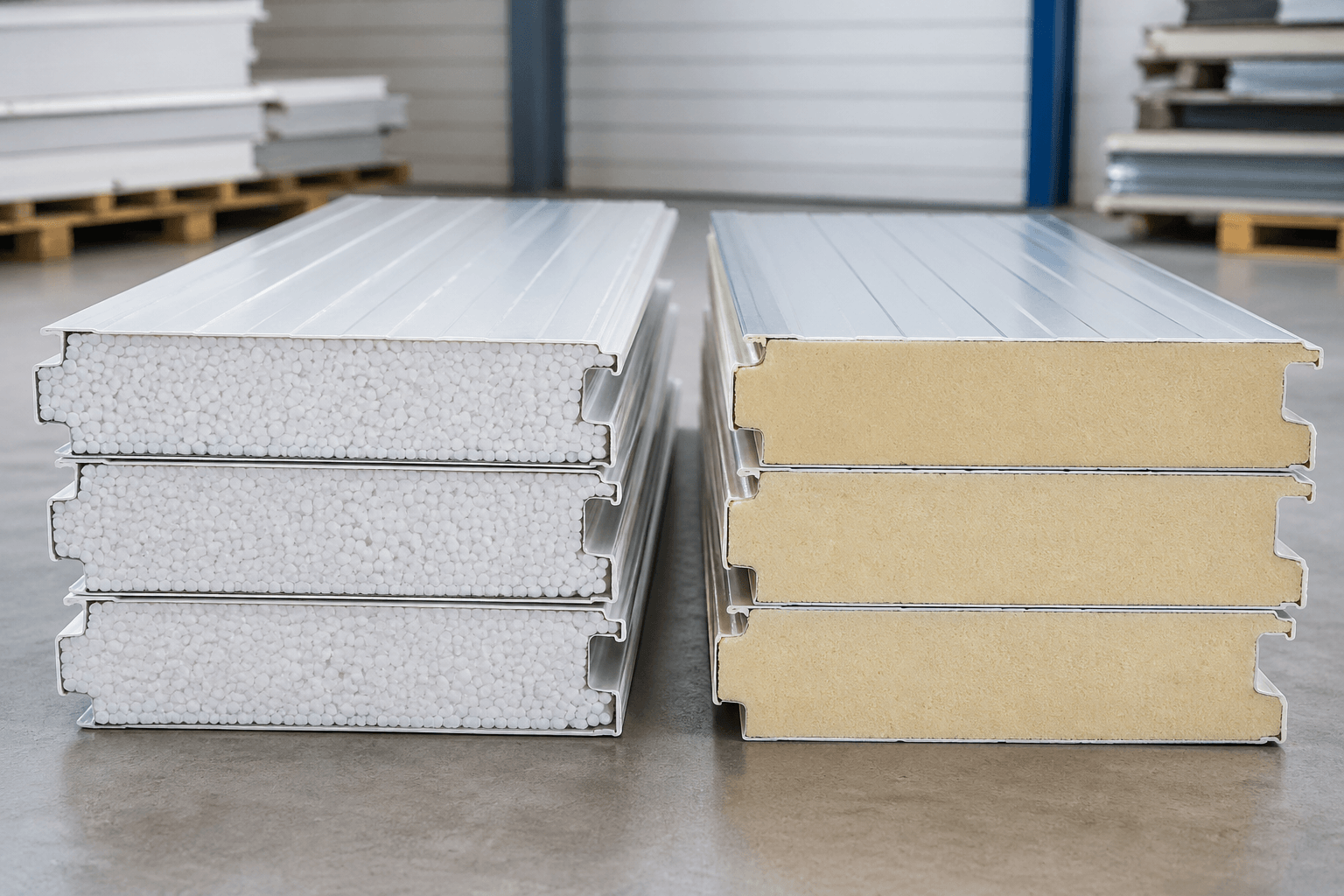
When planning a commercial or industrial build, choosing the right panel system is critical for performance, cost, and long-term efficiency. Two commonly used options are insulated wall panels and sandwich panels—but what’s the difference, and which is better for your project?
Understanding the difference between sandwich panels and insulated panels is essential when choosing the right solution for commercial or cold storage construction. In this guide, we break down how they compare, where each is used, and how to choose the right solution.
What Are Insulated Wall Panels?
Insulated wall panels are pre-fabricated building materials designed to provide strong thermal performance and structural integrity. They are commonly used in coolrooms, warehouses, and food-grade facilities where temperature control is essential.
These panels typically consist of an insulating core—such as PIR or EPS—bonded between two outer layers, offering excellent energy efficiency and fast installation.
Learn more in our detailed guide: Insulated Wall Panels Explained Your Ultimate Guide To Energy Efficient Construction
What Are Sandwich Panels?
Sandwich panels are a broader category of composite panels made from three layers:
- Outer metal skins (usually steel)
- A core insulation material (PIR, EPS, or mineral wool)
In fact, insulated wall panels are a type of sandwich panel. However, the term “sandwich panels” is often used more broadly across industrial construction, including roofing and wall systems.
Explore product options: Coolroom Panels
Key Differences: Insulated Wall Panels vs Sandwich Panels
| Feature | Insulated Wall Panels | Sandwich Panels |
| Definition | Specific application (walls) | Broad category (walls, roofs, facades) |
| Usage | Coolrooms, food storage, clean rooms | Warehouses, factories, commercial builds |
| Performance | High thermal efficiency | Varies by core material |
| Terminology | More specific | More general industry term |
In most cases, the difference is terminology and application, not structure.
Which One Is Better?
The better option depends on your project requirements:
Choose Insulated Wall Panels if:
- You need precise temperature control
- You’re building a coolroom or freezer room
- Compliance with food safety standards is required
👉 See our solutions:
- https://www.burtonindustries.com.au/coolroom-panels/
- https://www.burtonindustries.com.au/freezer-rooms/
Choose Sandwich Panels if:
- You’re working on a large-scale industrial or commercial build
- You need flexibility across walls and roofing
- You’re comparing different insulation cores and finishes
Why Panel Choice Matters
Selecting the right panel impacts:
- Energy efficiency
- Installation time
- Long-term operating costs
- Compliance with Australian building standards
For example, high-quality insulated panels can significantly reduce energy usage in temperature-controlled environments. According to the Australian Government – YourHome, well-insulated building materials play a key role in reducing heating and cooling demands.
Work With Melbourne’s Panel Experts
At Burton Industries, we supply high-performance insulated panel systems designed for Australian conditions. Whether you’re building a coolroom, warehouse, or commercial facility, our team can help you choose the right solution.
Get expert advice or request a quote today. Contact Us.
FAQs
- Are insulated wall panels the same as sandwich panels?
Yes—insulated wall panels are a type of sandwich panel. The difference mainly comes down to how the term is used in the industry.
- Which panel is best for coolrooms?
Insulated wall panels with high-performance cores (like PIR) are best for coolrooms due to their superior thermal efficiency.
- Are sandwich panels energy efficient?
They can be, depending on the insulation core. PIR panels generally offer the best thermal performance.
- Can sandwich panels be used for roofing?
Yes—sandwich panels are commonly used for both wall and roof applications in commercial and industrial construction.