
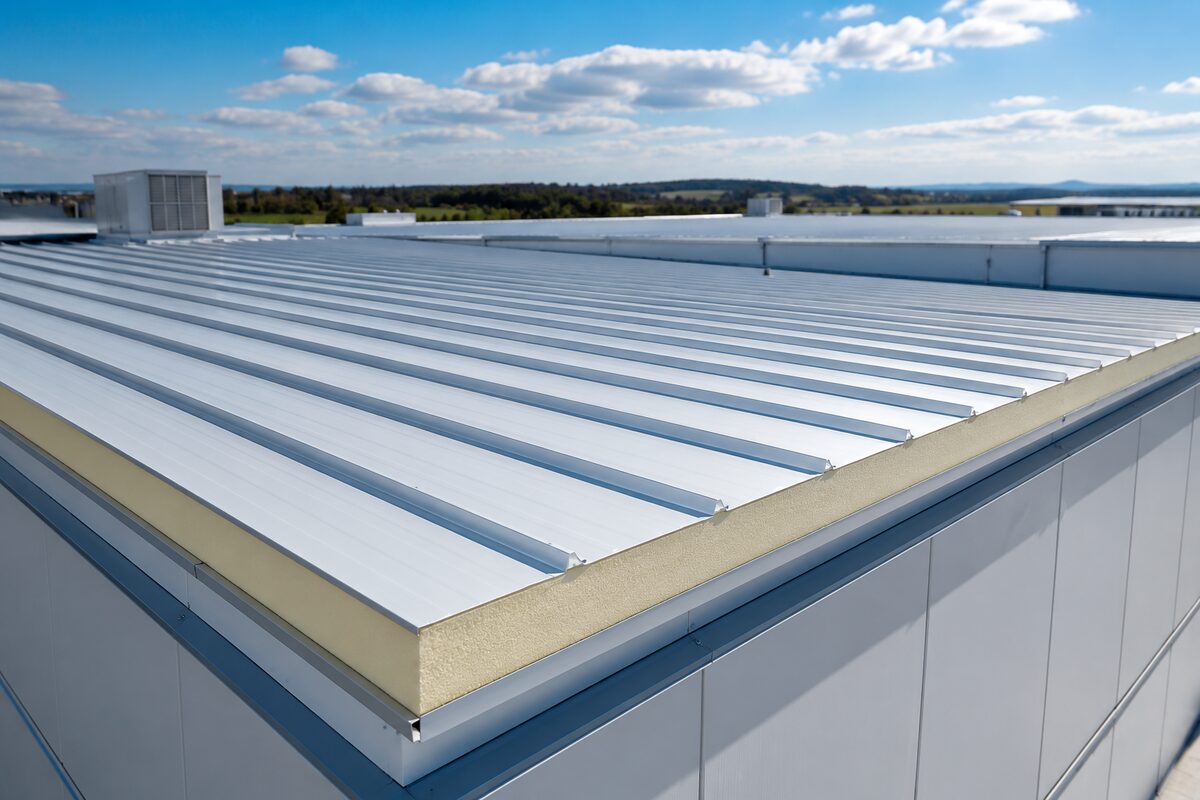
The roof of a cold storage building plays a major role in maintaining temperature, controlling energy costs and protecting products stored inside. For coolrooms, freezer facilities, food processing plants and refrigerated warehouses, standard roofing materials may not provide the level of thermal performance required.
This is where sandwich panel roof can provide a practical solution. Combining durable outer metal sheets with an insulated core, sandwich roof panels provide both structural protection and thermal insulation within a single system.
If you’re planning a cold storage facility, here’s what you should know before choosing insulated roofing panels.
What Is Sandwich Panel Roof?
Sandwich panel roof consists of an insulating core positioned between two durable metal facings. The result is a lightweight, prefabricated panel that combines insulation and external protection.
Depending on the application, the insulation core may be manufactured from materials such as EPS or PIR.
Sandwich roof panels can be particularly useful for:
- Cold storage warehouses
- Food processing facilities
- Distribution centres
- Temperature-controlled production areas
- Agricultural storage facilities
- Commercial and industrial buildings
For refrigerated environments, the principle is similar to the insulated sandwich panels used to construct coolroom walls and ceilings: creating an effective thermal barrier between the controlled interior and surrounding environment.
Why Roof Matters in a Cold Storage Building
Heat doesn’t only enter a building through its walls. The roof can be exposed to significant solar heat throughout the day, particularly during Melbourne’s warmer months.
If the roof system provides inadequate insulation, refrigeration equipment may need to work harder to maintain the required internal temperature.
An effective insulated roofing system can help:
- Reduce unwanted heat transfer
- Maintain more stable internal temperatures
- Reduce demand on refrigeration equipment
- Improve overall building energy efficiency
- Control condensation when correctly designed
- Support consistent product storage conditions
For businesses operating refrigeration equipment around the clock, these efficiencies can become particularly important over the life of the building.
EPS vs PIR Sandwich Roof Panels
One of the key decisions when specifying sandwich panel roofing is the insulation core.
EPS Panels
Expanded polystyrene (EPS) is lightweight and provides effective thermal insulation for many applications. EPS insulated panels are widely used in cold storage construction because of their versatility and cost effectiveness.
PIR Panels
Polyisocyanurate (PIR) provides strong thermal performance and may be specified where particular thermal or fire-performance requirements apply.
The appropriate material should never be selected based on price alone. Building classification, fire requirements, temperature, panel span and the intended use of the facility should all be considered during specification.
The National Construction Code (NCC) establishes minimum requirements for safety, health, amenity and sustainability in Australian buildings. Its requirements should be considered alongside engineering, manufacturer specifications and applicable Australian Standards when designing a cold storage building.
How Thick Should Sandwich Panel Roofing Be?
There isn’t one panel thickness that is right for every cold storage project.
The appropriate specification can depend on:
- Required internal temperature
- External environmental conditions
- Building size
- Insulation core
- Thermal performance requirements
- Refrigeration load
- Structural requirements
A refrigerated warehouse operating above freezing, for example, may have different insulation requirements from a low-temperature freezer facility.
This is why panel thickness and insulation performance should be considered as part of the complete cold storage design rather than as an isolated purchasing decision.
Condensation and Vapour Control
Condensation is an especially important consideration in refrigerated buildings.
Temperature differences between the interior and exterior can create conditions where moisture forms within or around the building envelope. Poor panel joints, inadequate sealing or unsuitable detailing can contribute to condensation, moisture ingress and reduced thermal performance.
Correct installation therefore matters just as much as panel selection.
Panel joints, penetrations, flashings and interfaces between the roof and wall system should be properly detailed to create a continuous insulated envelope.
You can learn more about how insulated panels work in our guide, Refrigeration Wall Panels Explained: What They Are & Why They Matter.
What About Fire Performance?
Fire performance is another important consideration when choosing insulated sandwich panels.
Requirements can vary significantly according to the type, size and classification of the building and the materials being used. Rather than assuming one insulation core is suitable for every project, owners should ensure the proposed panel system meets the applicable building and fire requirements for their facility.
For Australian projects, the National Construction Code from the Australian Building Codes Board is an authoritative starting point for understanding applicable building requirements.
Sandwich Panel Roofing vs Conventional Roofing
For a temperature-controlled facility, the lowest-cost roofing material isn’t necessarily the most economical option over the building’s lifetime.
Conventional roofing may require separate insulation systems and additional detailing to achieve the required thermal envelope. Insulated sandwich roofing combines multiple functions within one prefabricated system.
Potential advantages include:
- Faster installation
- Consistent insulation
- Fewer separate construction layers
- Good thermal performance
- Clean internal finishes
- Long-term durability
The correct choice ultimately depends on the building design, operating temperature, budget and regulatory requirements.
Think About the Entire Cold Storage Envelope
A high-performance roof alone won’t make an inefficient cold storage facility efficient.
Walls, ceilings, doors, flooring, panel joints and refrigeration equipment all contribute to overall performance. The best results come from treating the facility as one complete thermal envelope.
For businesses planning a complete facility, Burton Industries also provides commercial coolrooms, freezer rooms and insulated panel solutions tailored to different cold storage applications.
Talk to Burton Industries About Your Cold Storage Project
Choosing the right sandwich panel roofing starts with understanding what the building actually needs to achieve. Temperature requirements, insulation performance, panel construction, building compliance and long-term energy efficiency should all be considered before a system is specified.
With more than 50 years of experience in insulated panels and cold storage construction, Burton Industries can help businesses plan reliable solutions for coolrooms, freezer facilities and other temperature-controlled environments.
Whether you’re constructing a new cold storage building, expanding an existing facility or reviewing your insulated panel requirements, contact Burton Industries today to discuss the right solution for your project.
Call 03 9729 8155 to speak with the Burton Industries team or request a quote.